1 Sapienza University of Rome2 University of Verona3 Polytechnic of Turin4 Fondazione Bruno Kessler5 Reykjavik University
* Work done before joining Amazon.
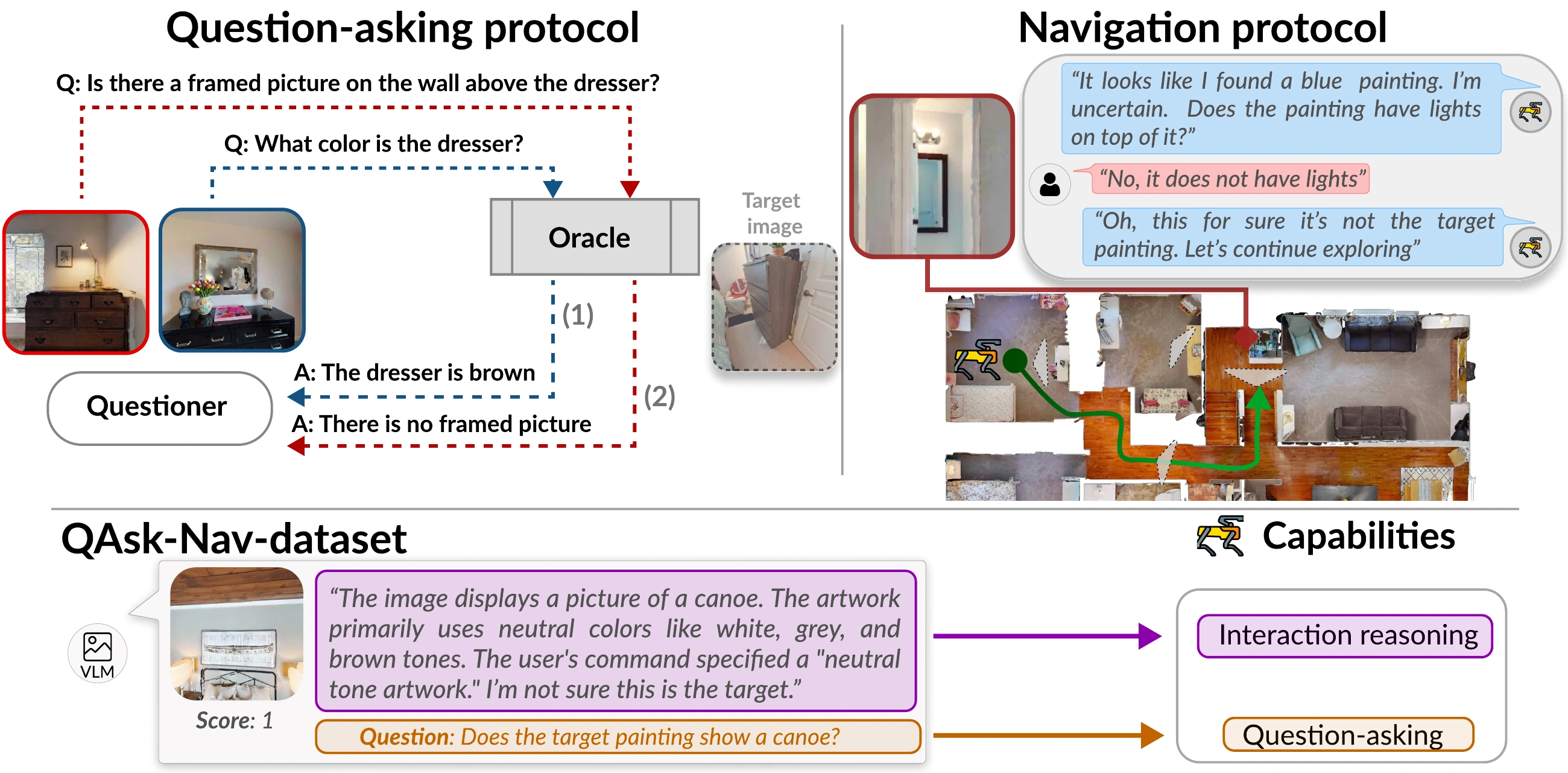
How well does a navigation agent ask for help? QAsk-Nav measures interaction quality separately from navigation success.
Three complementary components: a standalone question-asking protocol, an improved navigation protocol, and a dataset of reasoning and interaction traces.
Abstract
Collaborative Instance Object Navigation (CoIN) asks an embodied agent to find a specific object described in natural language (e.g. 'The beige bed with a blue comforter near the open window'), using visual observations and dialogue with a user. When several objects look alike, the agent can ask questions to the user to resolve ambiguity. Yet navigation success alone does not tell us how well the agent collaborates.
We introduce Question-Asking Navigation (QAsk-Nav), a reproducible benchmark with separate protocols for question-asking and navigation. It combines a lightweight interaction evaluation, improved navigation target descriptions, and approximately 26,000 quality-checked reasoning and question-asking traces. Using this data, we train Light-CoNav, a unified 7B vision-language model, that can be used on top of any modular navigation policy. It improves question-asking over navigation-ready baselines and generalizes better to unseen objects than AIUTA, while using approximately three times fewer parameters and over 70 times faster interaction inference.
The QAsk-Nav benchmark
Separate evaluations make it possible to study the conversation itself, rather than deriving from slow and expensive navigation simulations.
01
Question-asking
The questioner sees a candidate object and the target description. An oracle has access to the target image. The agent asks free-form questions or decides whether the candidate matches the target.
Multi-turn episodes with hard synthetic distractors · No navigation simulator required
02
Navigation
Evaluate collaborative navigation in Habitat using HM3D scenes, with clearer target descriptions and an improved VLM oracle. The protocol covers seen objects, synonyms, and unseen objects.
~1.6K episodes · 81.6% human preference for the new descriptions
03
QAsk-Nav Dataset
QAsk-Nav-dataset pairs observations and descriptions with reasoning, an uncertainty score, a question when needed, and previous dialogue. It supports training and analyzing interactive agents.
Fine-tuned in two stages: for reasoning and uncertainty estimation; then, for question generation with dialogue context. The interaction model can work with any modular navigation policy that uses object detections.
Results
Better interaction and unseen-object navigation, with substantially lower interaction cost.
45.10%
Question-asking success vs. 30.27% for AIUTA
9.63%
Unseen navigation success vs. 7.83% for AIUTA
~70×
Faster interaction inference 2.49 s vs. 185.79 s for AIUTA
Question-asking, evaluated independently
Mean results across the six description types and three VLM oracles. The AIUTA and Light-CoNav entries refer to their interaction modules.
Question-asking results (paper, Table 1)
Model
SR (%) ↑
FR (%) ↑
Questions ↓
Qwen2.5-VL-7B
7.52
0.34
2.74
AIUTA
30.27
19.93
1.15
Light-CoNav ours
45.10
33.17
0.20
Qwen3-VL-30B-A3B
32.05
27.55
0.12
Gemini-3-flash
93.29
89.43
0.96
SR: fraction of correct decisions per episode. FR: fraction of episodes with all decisions correct. Questions: mean per observation. The last two rows are larger or closed-source comparison models.
Navigation with QAsk-Nav descriptions
Navigation success rate, % (paper, Table 4)
Model
Seen ↑
Synonyms ↑
Unseen ↑
SenseAct-NN
6.62
13.09
0.22
PSL
8.78
8.91
4.58
OVON
8.18
15.88
2.61
VLFM
0.36
0.00
0.00
AIUTA
10.46
14.89
7.83
Light-CoNav ours
12.20
14.15
9.63
The efficiency comparison uses interaction inference time (paper, Table 6), not full navigation runtime. Light-CoNav uses 7B parameters versus AIUTA's 20B.
What remains difficult? Light-CoNav struggles with ambiguous category-only descriptions, and larger models still lead on question-asking. In general, the CoIN task remains hard.
Citation
@article{zorzi2026benchmarking,
  author       = {Edoardo Zorzi and
                  Francesco Taioli and
                  Yiming Wang and
                  Marco Cristani and
                  Alessandro Farinelli and
                  Alberto Castellini and
                  Loris Bazzani},
  title        = {Benchmarking Interaction, Beyond Policy: a Reproducible Benchmark
                  for Collaborative Instance Object Navigation},
  journal      = {CoRR},
  volume       = {abs/2604.00265},
  year         = {2026},
  url          = {https://doi.org/10.48550/arXiv.2604.00265},
  doi          = {10.48550/ARXIV.2604.00265},
  eprinttype   = {arXiv},
  eprint       = {2604.00265},
}
Acknowledgments
We thank Gianni Franchi for helpful discussions, Google and LambdaLabs for computing credits, and ISCRA for access to LEONARDO at CINECA. This work was supported by the Ministero delle Imprese e del Made in Italy (IPCEI-CL-0000007), the European Union (Next Generation EU), PNRR MUR project PE0000013-FAIR, and PR Veneto FESR 2021–2027 24729-002238-SINERGHY. See the paper for full acknowledgments.